Side-Channel Analysis of DES and SPECK32
What is Side-Channel Analysis
Side-Channel Analysis (SCA) exploits physical leakage from cryptographic implementations rather than mathematical weaknesses. Power consumption is data-dependent and can reveal information about intermediate computations.
Leakage Model
The Hamming Weight (HW) model is used:
HW(x) = number of bits set to 1 in x
Power consumption is assumed to be proportional to the Hamming Weight of intermediate values.
SPECK32: Synthetic Trace Generation
Synthetic traces are generated by recording HW values of intermediate operations during encryption:
- rotation output
- modular addition result
- XOR with round key
- final mixing stage
Each round produces four leakage samples.
Trace length = 22 × 4 = 88 samples
Dataset characteristics:
- 10,000 traces
- fixed secret key
- random plaintexts
- Gaussian noise added
- random desynchronization applied
This simulates realistic measurement conditions.
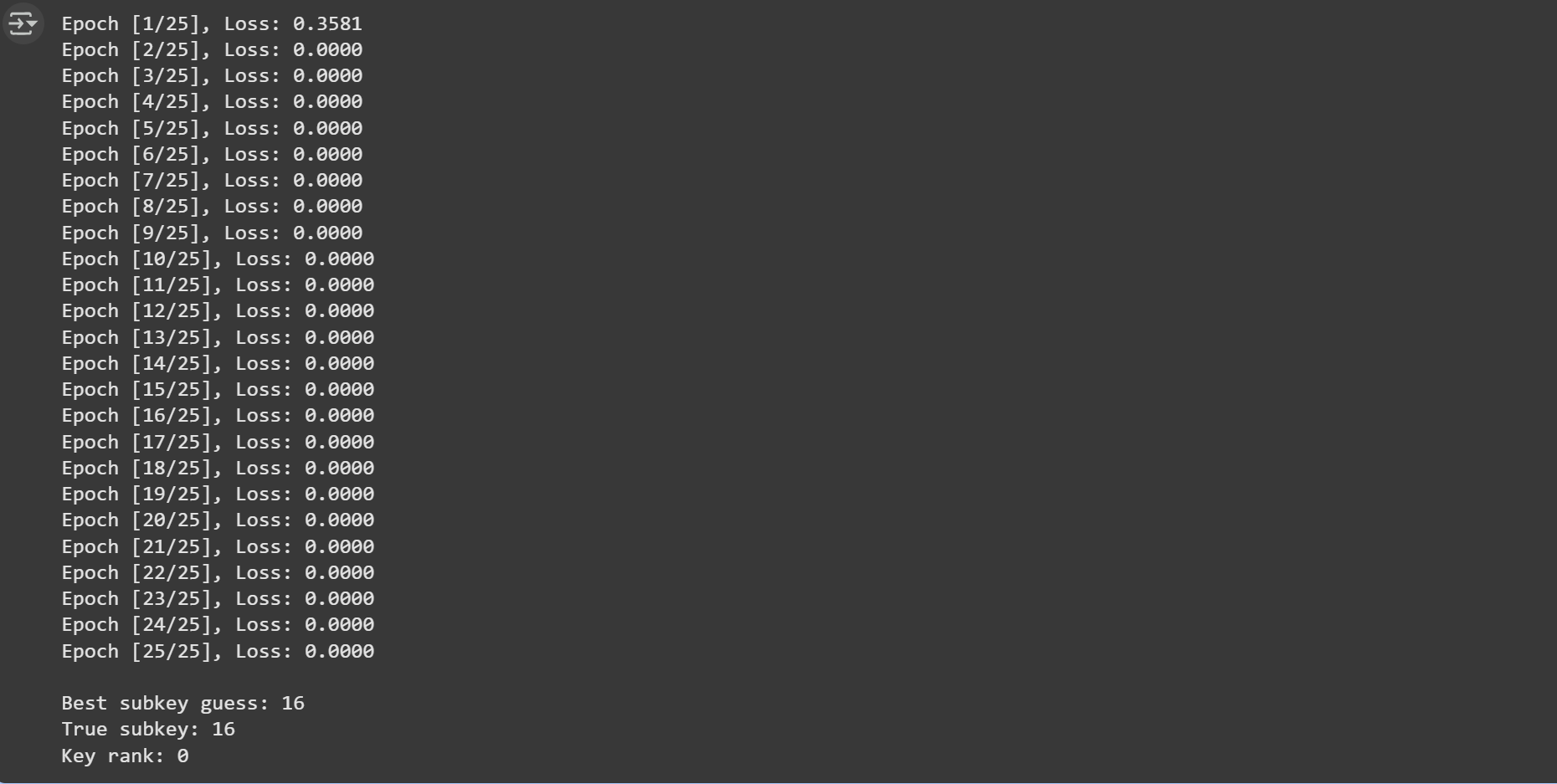
CNN-Based Key Recovery for SPECK32
A Convolutional Neural Network is trained to learn the mapping:
trace → key class
Key rank is used as the evaluation metric.
Rank 0 indicates successful key recovery.
DES S-box Side-Channel Attack
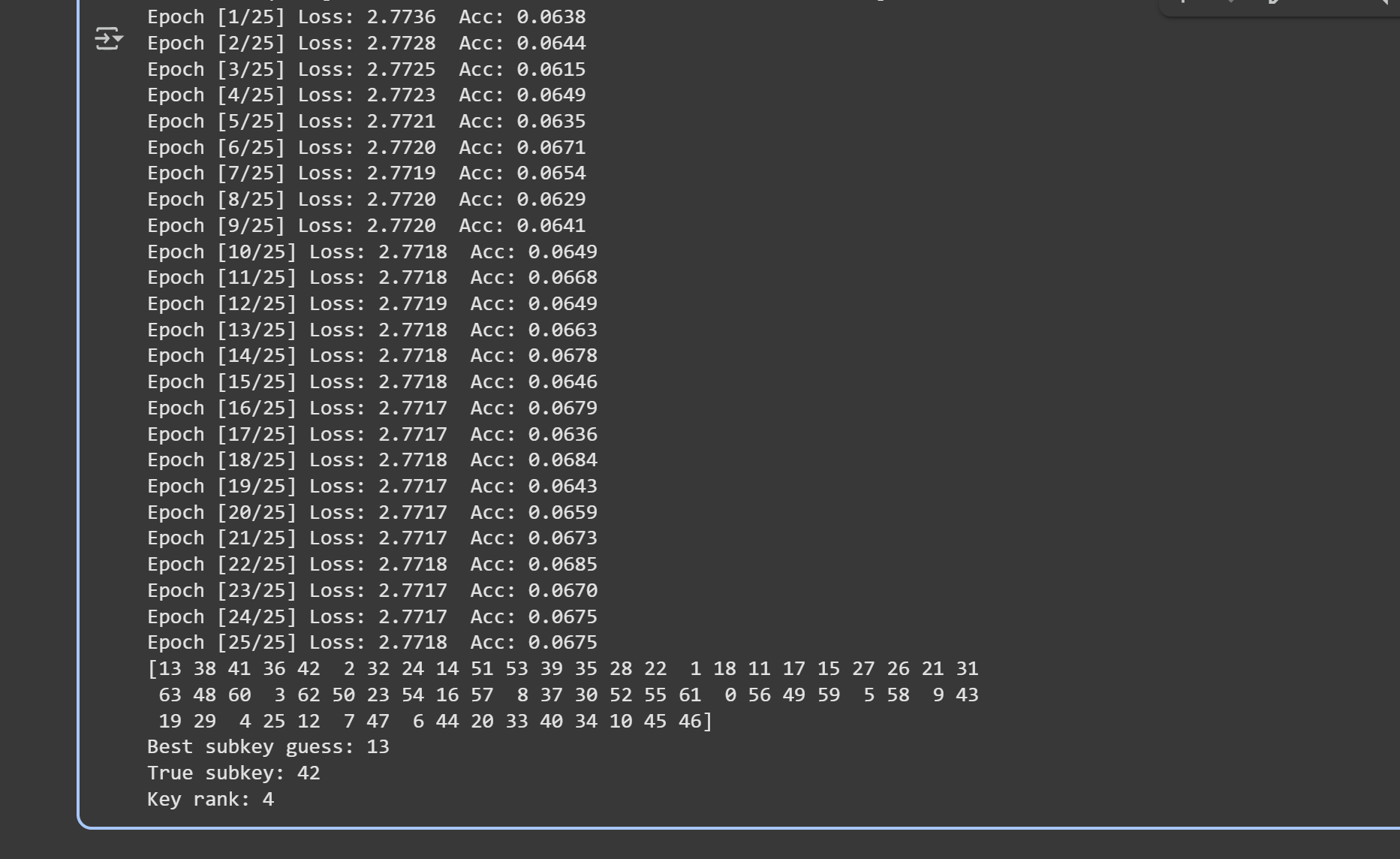
Instead of predicting the key directly, the model predicts the S-box output (16 classes).
Key recovery procedure:
- Compute S-box output for each key hypothesis
- Accumulate log-likelihoods across traces
- Select the key with maximum likelihood
This follows the template attack methodology with deep learning feature extraction.
Advantages of Deep Learning in SCA
- automatic detection of leakage points
- robustness to noise and misalignment
- no manual feature engineering required